January 2027: three changes to the Dutch energy market
Insights by Oliver Joy, Product Analyst at Eneve
Three changes, one direction
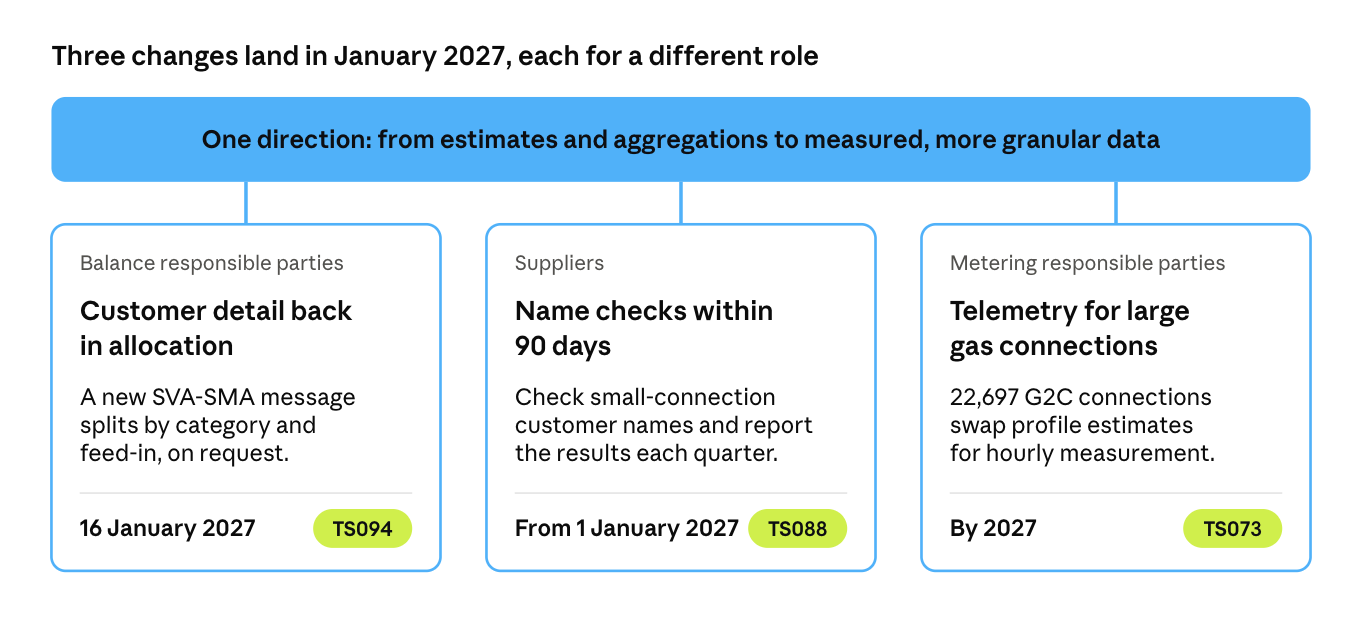
The January 2027 market release brings three changes to the Dutch energy market. Each one replaces estimates and aggregations with measured, more granular data.
That is good news for the market. Balance responsible parties get the detail they need for sharper forecasts. Suppliers build cleaner customer records, and large gas connections move to hourly measurement.
It also asks for new processes and system changes, with the first deadlines landing in the first half of 2027. This overview is based on analysis by Oliver Joy, Product Analyst at Eneve. Below, we walk through each change: what it is, who it affects and what to prepare.
1. Balance responsible parties get their customer detail back
For balance responsible parties (BRPs). Market topic TS094.
Since May 2026, many connections that used to be allocated on estimated profiles have moved to smart meter allocation (SMA). Allocation volumes are now based on measured smart meter data, which makes them more accurate.
The switch did lose two details that profile allocation used to provide:
- Customer category: E1B, E1C, E2B and E4A, which describe connection size and tariff type.
- Feed-in: whether a connection also feeds energy back into the grid, for example from solar panels. In Dutch market terms this is AMI/AZI (afname met of zonder invoeding, meaning consumption with or without feed-in).
BRPs use both details to forecast more accurately and to distribute costs fairly across customer groups.
What changes
From 16 January 2027, a new allocation message called SVA-SMA brings this detail back. It arrives as a separate data flow next to the existing aggregated SMA allocation message (N111).
N111 splits volumes by energy direction and origin. SVA-SMA adds the split by customer category and feed-in, in kWh per imbalance settlement period.
How it works
There is one important difference with other allocation messages: SVA-SMA only arrives when you ask for it.
- The BRP sends a request for one system area, identified by its EAN code, and exactly one calendar day.
- The grid operator replies with the most recently determined allocation volumes for that day.
A few details matter for planning:
- You always get the latest run. There is no option to request a specific version. Use the request time, or the determination timestamp in the response, to see which run you have.
- Every run is available. You can request data for D+1, D+3, D+5, D+8 and D+10. Provisional figures arrive by D+3 working days, final figures by D+10 working days.
- Data has a shelf life. It can be retrieved up to two months after the delivery date.
What happens until then
Since 18 May 2026, BRPs have received zipped CSV files for SMA allocation through the Message Box as a temporary measure, opened with a password from the grid operator. The files came weekly at first and every two weeks from 1 July.
This transition measure ends when SVA-SMA goes live on 16 January 2027.
What this means for you
- Build the request-response flow before 16 January. Without it, customer category and feed-in detail drops out of your forecasts when the CSV files stop.
- Automate the requests. One request covers one day for one system area, so a BRP active in several areas needs many requests every day.
- Store what you retrieve. After two months, the data is no longer available.
- Build it once, use it more widely. The underlying service, "request aggregated allocation volumes", is generic. For now it only covers SMA, but its message model also suits other allocation groups such as TMT and PRF.
2. Suppliers verify customer names within 90 days
For suppliers. Market topic TS088.
Suppliers arrange the connection and transport agreement (in Dutch: aansluit- en transportovereenkomst, or ATO) between small-connection customers and their grid operator. That agreement needs the right customer name on it.
Under the Energy Regulation (Energieregeling), suppliers now also verify that this name is reliable and complete.
What changes
From 1 January 2027, suppliers verify the name of each small-connection customer within 90 days of the start of supply. They compare the registered name with:
- the bank account holder, or
- an approved eIDAS electronic identification method.
Where they find an error, they correct it. Where they can't establish the right name, they notify the grid operator.
Five possible outcomes
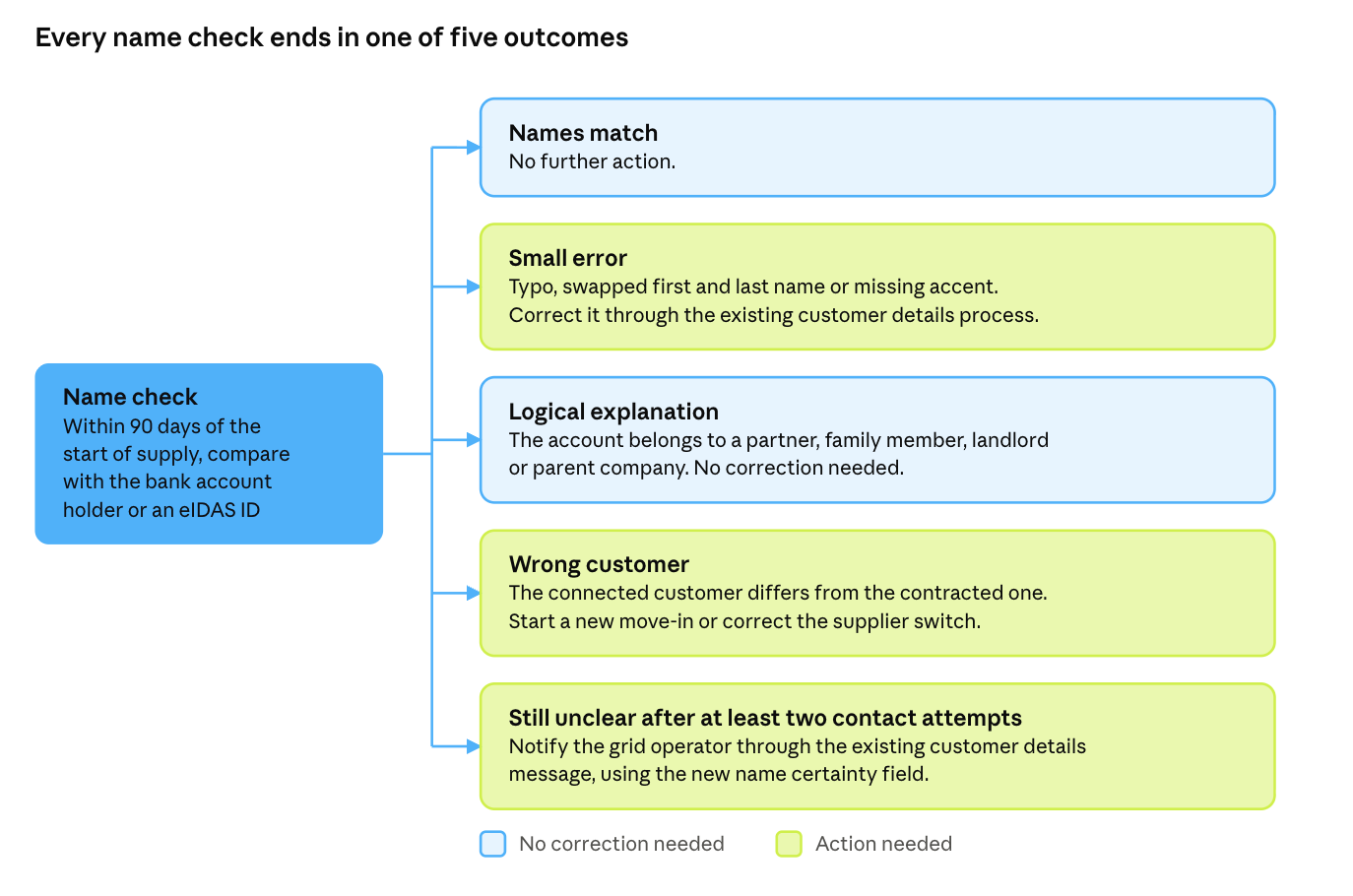
Two outcomes need no correction. The other three each start a specific process, from a quick fix to a notification to the grid operator.
Two new reporting obligations
|
Obligation |
What it does |
When |
|---|---|---|
|
Individual notification of name uncertainty |
Tells the grid operator that the supplier could not verify a specific customer's name |
As soon as possible once the name can't be verified, after at least two contact attempts |
|
Quarterly name verification report |
Gives the grid operator aggregated statistics on all name checks |
Within six weeks of each quarter end |
The individual notification runs through the existing "change connected party details" message, introduced in the May 2026 release. It gets one new optional field, NameCertaintyValidationResult, which only takes the value "No". When the field is absent, the check is still running or the supplier is certain of the name.
One practical note: the notification only works for the current supplier of the primary allocation point. If you spot a problem before supply starts, wait until your registration appears in the connections register.
The quarterly report covers:
- total checks started
- successful matches
- mismatches, split into minor spelling errors, logically explainable mismatches, identity uncertainty and wrong customer
- checks that could not be performed
- checks still in progress, where the 90 days have not yet passed
Suppliers can add their own observations, such as common reasons for failed checks or unusual cases. The first report covers 1 January to 31 March 2027 and is due within six weeks of 31 March 2027.
API and qualification
- Version 3 of the ConnectedPartyManagement API, with the new field, is available from 1 January 2027.
- Version 2 stays available until 1 April 2027, so both versions run side by side until 31 March 2027.
- Suppliers who qualified during the May 2026 release, or who use the web interface, don't need to qualify again.
What this means for you
- Build the check into onboarding. Every supply start needs a name check within 90 days, so track that clock per customer.
- Log every outcome from 1 January. Use the same categories as the quarterly report, since reconstructing them afterwards is much harder.
- Record contact attempts. Identity uncertainty can only be reported after at least two attempts to reach the customer.
- Plan the API move. Switch to version 3 before 1 April 2027.
3. Large gas connections move to measured data
For metering responsible parties, and relevant for suppliers of large gas customers. Market topic TS073.
Under the new Energy Act (Energiewet), every large gas connection in category G2C needs a meter with communication functionality by 2027.
G2C connections are large gas connections that still rely on profile-based estimates instead of real-time measurement. In December 2025, around 22,697 connections fell into this category.
Every G2C connection must:
- replace its existing meter with a telemetry-enabled meter
- record hourly data and send it remotely
- switch from profile-based estimates to real measurement
In practice, this ends the use of profile meters for large gas connections.
What stays the same
This change is about the meters. The allocation methodology for these connections stays as it is for now.
What this means for you
- Metering responsible parties: plan meter exchanges across roughly 22,700 sites before the deadline.
- Suppliers of large gas customers: expect meter exchanges at your customers' sites. It's a good moment to give them a heads-up.
- Anyone with a large gas portfolio: keep an eye on allocation. The market documentation says the methodology doesn't change yet, so hourly measured data may play a bigger role later.
Key dates
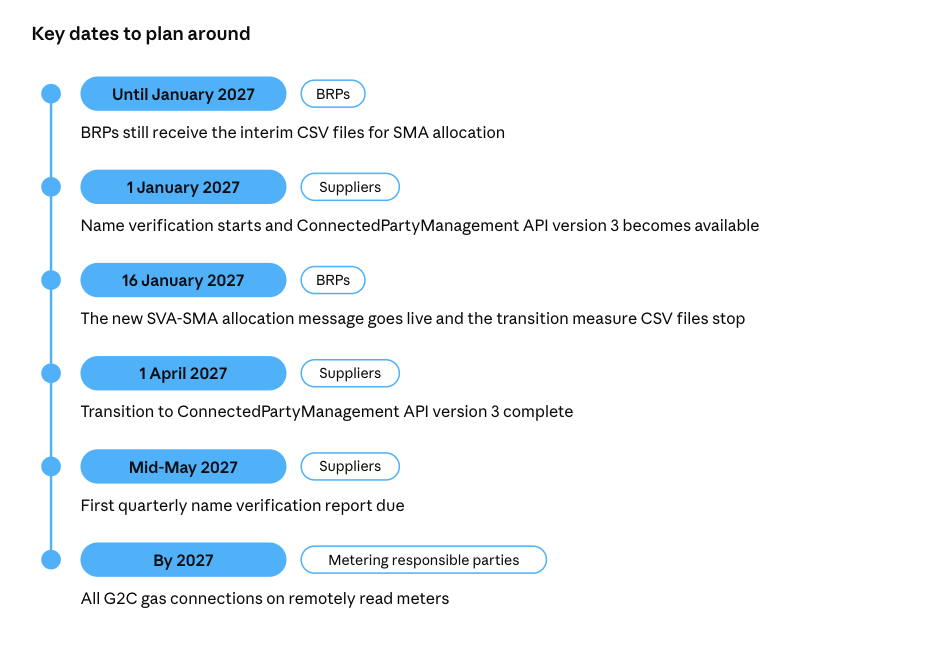
Large gas connections in category G2C need remotely read meters by 2027. The market documentation gives no exact date for that switch, so it sits outside this timeline.
Ready for January?
The first changes go live in January 2027, and the first quarterly supplier report is due by mid-May. Starting now leaves time to build, test and automate before the deadlines arrive.
Each change touches your data flows, customer processes or systems in a different way. Want to know what they mean for your setup? Our market experts are happy to walk you through it. Get in touch.