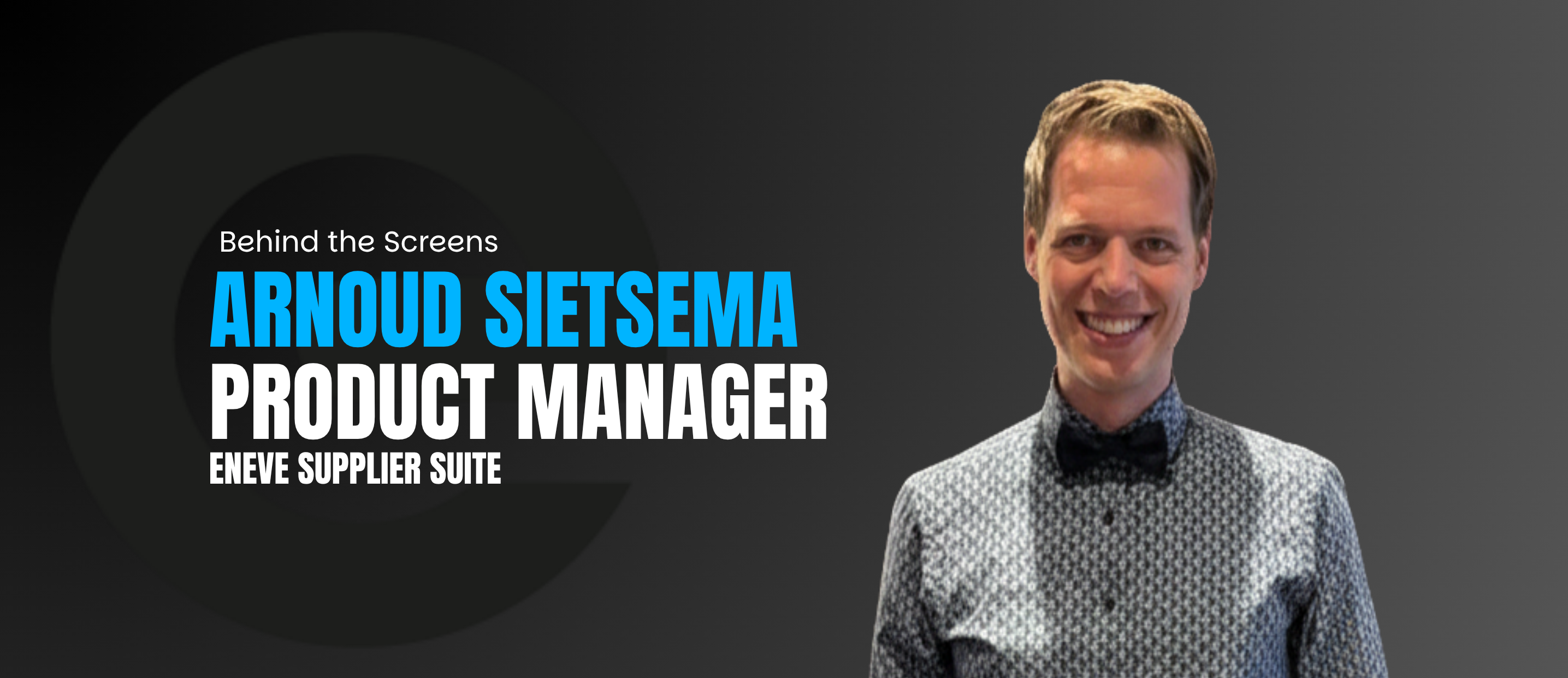
“Built to run itself'': Arnoud Sietsema on Eneve's billing & ops product
Behind the Screens at Eneve
There's a kind of ambition that doesn't announce itself. It shows up at a company barbecue, stands to the side while colleagues laugh and eat, and thinks: we helped make this possible.
That's Arnoud Sietsema. And it tells you a lot about how he builds product.
Arnoud joined what is now Eneve's billing and operations solution (previously Ecedo) in 2017 through a secondment. His job description for the first two years was simple: just help us. He did, and kept going.
From engineer to product owner, almost by accident
Arnoud trained as a software engineer. But early on, he realised his favourite part of the job wasn't writing code. It was the conversation before any code was written.
"I always found it interesting to talk to customers about what they needed and understand why they wanted something built. Sometimes a customer would say 'I need you to build this,' and through the conversation we'd change the entire thing to better suit what they actually needed."
When he joined the Ecedo team, there was no product owner. So he became one. He was already talking to customers as a consultant; translating those conversations into user stories was a natural next step.
What made the early years work was proximity to customers. The first five weren't just clients. "We basically asked for a lot of input from all of them. They were all helping us shape the product to their needs." No single customer drove the roadmap, but together they did.
The feature he's most proud of
Ask Arnoud which feature he's most proud of, and he doesn't hesitate: dynamic invoicing.
"We built it from scratch. There were only a few companies starting to do it at the time. We studied what they did, and then built our own version from there." Today, market-price invoicing is standard. Back then, it was a bet.
The team rarely builds without at least one customer who has asked for something and is willing to launch with it. But once that signal exists, they build it their way.
"My ideal is that there are very few users in the product at all. It should run by itself, or at least through integrations. The less user interaction needed, the better."
But press him, and a more specific answer comes. He'd want to watch someone handle anomalies. The energy market is full of variables that produce seemingly random outcomes. When something goes wrong, can a user drill down and find the cause?
"Everything routine should flow automatically. But when something unexpected happens, we need to give users the tools to investigate. I'd want to see whether we've done that well enough."
Price Blocks and the energy transition
The feature Arnoud is most excited about right now is Price Blocks, and his enthusiasm goes well beyond the product itself.
Smart meters and grid infrastructure were designed decades ago. A "normal" tariff ran from 7am to 11pm; a "low" tariff covered nights and weekends. That made sense back then. It doesn't anymore.
"Our energy mix has changed completely," he says. "Solar and wind create overproduction at specific periods. Consumption hasn't shifted to match it. Renewable energy is being wasted because the price signals aren't reaching the end consumer."
Price Blocks solves a hardware problem with software. It lets suppliers define their own tariff windows without replacing meters in the field.
"Customers on a fixed contract can still be steered toward periods when energy is green, because that's when it's cheapest. It really helps us transition to greener electricity as a society."
One customer is already running it in production. A broader launch is coming.
Product synergies at Eneve
Eneve's billing and operations solution has always been API-first. Not as a technical preference, but as a philosophy.
"We're one of the core products our customers depend on, and we don't want to hold them back," Arnoud says. "If a customer wants to send emails through Salesforce because they think it's better at it, that's fine. We have APIs for everything."
That openness is what allowed Eneve's onboarding solution (previously GridHub) to grow the way it did. What started as one customer needing a cleaner sales channel integration became a full portal platform.
"They integrated with us because we were open and we liked the people. We gave them advice: use this API like this, that one like that. And then it really took on a life of its own." He says it with affection.
His view on the relationship going forward: the two teams should operate as one, with two code bases. "When we release a feature and the onboarding solution doesn't support it, that limits the value for our customers immediately."
For customers looking to launch fast, the combination already delivers.
How Arnoud thinks about product
Arnoud's ideal workday is quiet, because product thinking requires uninterrupted time.
"I want to think through all the impact. Not just where we want to go, but where we actually are right now. You can only plan a route if you know your starting point."
His approach is not always the most direct path, but the one that builds the right architecture for wherever the product needs to go next.
When asked for his top skills, Arnoud lists three: deep product knowledge, memory for why decisions were made, and thinking through all the variables and use cases before committing.
Then he adds a fourth: humour.
"Work shouldn't be unbearable. I always try to have fun. Annoy people a little, in good spirit, so we have a few laughs during the day."
The human side of a long-term builder
Outside work, Arnoud is a father and someone who still programmes for fun. As of last year, he also shoots bow and arrow. He's a beginner at it. He's not bothered.
What he'd want to be remembered for comes down to two things.
The first is culture. Arnoud has always tried to give people around him the confidence to make their own decisions, and to be wrong sometimes. His least favourite question: Arnoud, what should I do? The version he wants instead: Arnoud, I have this problem. I think I should do this.
"They might be wrong. But they've thought about it. And from that you can actually coach someone."
The second is harder to describe but easier to picture. A barbecue, years ago. Colleagues enjoying themselves. Arnoud standing to the side, watching.
"I felt really grateful that we were able to bring joy to the lives of all these people. They had a job, an income, they were supporting their families. And they were just enjoying themselves. That was the goal."
He also shares one ritual that says it plainly. Whenever customers sent gifts, he never took them home. He left them at the office to be shared or raffled among the team.
"Someone being happy and sending me a gift doesn't mean I did the work. It means we did the work. So everyone should have a share in it."
Behind the Screens at Eneve spotlights the people and decisions shaping Eneve's software suite. Want to learn more about our solutions? Get in touch.
Related articles
.png?width=2871&height=1242&name=behind%20the%20Screens%20(5).png)
23-07-2026
The operational maturity curve: why some energy suppliers scale while others stall
Advisory · Supplier Operations
.png?width=2871&height=1242&name=behind%20the%20Screens%20(4).png)
.png?width=2871&height=1242&name=behind%20the%20Screens%20(3).png)
03-07-2026
''Dynamic energy market demands continuous steering'' Special Editorial with Michiel Kuiper, CEO at Eneve
Special Editorial · Energy Markets This article originally appeared as partner content in the Energietransitie edition of Het Financieele Dagblad, ...